
As a science teacher, assessment means more to me than seeing a student’s test score. I want to understand how they reached that score and how their learning is developing.
Quick answer: I use AI to prepare short quizzes, then use QuizRise quiz and Classroom analytics to look for learning gaps and plan my next teaching step. AI helps with preparation; interpreting the results and deciding how to respond remain my responsibility as the teacher.
The questions that matter most to me are: What do my students know now? Where are they struggling? Which learning objectives need more attention? What should I change in my next lesson?
In science lessons, students sometimes think they understand a concept while holding a basic misconception about it. Even a correct answer does not always show that they can apply the idea.
That is why I value assessing the same learning objective through different question types. Questions that ask students to interpret, connect and apply their knowledge help me see more than what they can recall. They also give me a clearer view of where students need support.
I see assessment as part of teaching, rather than something that happens only at the end of a unit. This is where formative assessment comes in.
What formative assessment means to me
I think of formative assessment as small, ongoing checks that help me understand where students are in their learning. The aim is to use that information to guide my next teaching decision.
This is the main difference from summative assessment. Carnegie Mellon University’s Eberly Center describes formative assessment as monitoring student learning to provide ongoing feedback, while summative assessment evaluates learning at the end of an instructional unit.
This fits the Education Endowment Foundation’s guidance on teacher feedback: formative assessment helps teachers identify learning gaps so that feedback can address them.
Imagine that I give my students a short, 10-question quiz after teaching a topic. A class average of 70% gives me a broad picture, but it does not answer the questions I find most useful:
- Which questions caused the most difficulty?
- How many students struggled with the same question?
- Do the errors relate to a particular learning objective?
- Can students recall the information but struggle to interpret it?
- Could there be a misconception about the underlying concept?
For example, imagine a Grade 8 lesson on Seasons and Climate. Students may have learned about Earth’s axial tilt and its orbit around the Sun. Most of the class might correctly answer a direct question such as, “What is one of the main reasons we have seasons?”
Yet I might see more incorrect answers when I assess the same objective using an Earth–Sun model, different dates or cities in different hemispheres.
That difference matters. It may suggest that students can remember the concept but struggle to apply it in another context. Instead of teaching the whole topic again, I might work with visuals, models and different question types that require interpretation.
Pressure offers another example. A student may correctly state that, when the same force is applied, solid pressure increases as the contact area decreases. The relationship is pressure = force ÷ area. But the student may struggle to apply it to an everyday problem involving objects with different contact areas.
If many students make similar errors, “The class average is 70%” is only part of the picture. A more useful interpretation might be: “My students can recall the basic rule about pressure, but they are struggling to apply it to a new situation.”
These interpretations lead to different teaching decisions. Looking only at the score might lead me to move to the next objective. Looking at the question-level results can show me what needs to change first.
Sometimes I need to question the assessment itself. If most students answer one question incorrectly, I should not immediately conclude that they have failed to learn the topic.
Was the wording clear? Was the visual easy to understand? Did I use an unfamiliar question format? Or do students share the same misconception?
Formative assessment is therefore also a way to review my own teaching. In the next lesson, I may revisit a concept, use a different example, run a short experiment or work with a smaller group of students.
The value of the data is that it helps me think about what to do next as a teacher.
Where AI fits in the process
I think AI’s most useful contribution to formative assessment is making preparation quicker and easier to fit into teaching. It does not replace the teacher’s decisions.
A short assessment involves more than writing questions. I also need to share it, collect responses, review the results and decide what to do next.
AI saves me time at the question-writing stage. I can create short quizzes from the topic or material I am using and assess the same objective through different question types. For example, QuizRise lets me create quiz questions from a PDF.
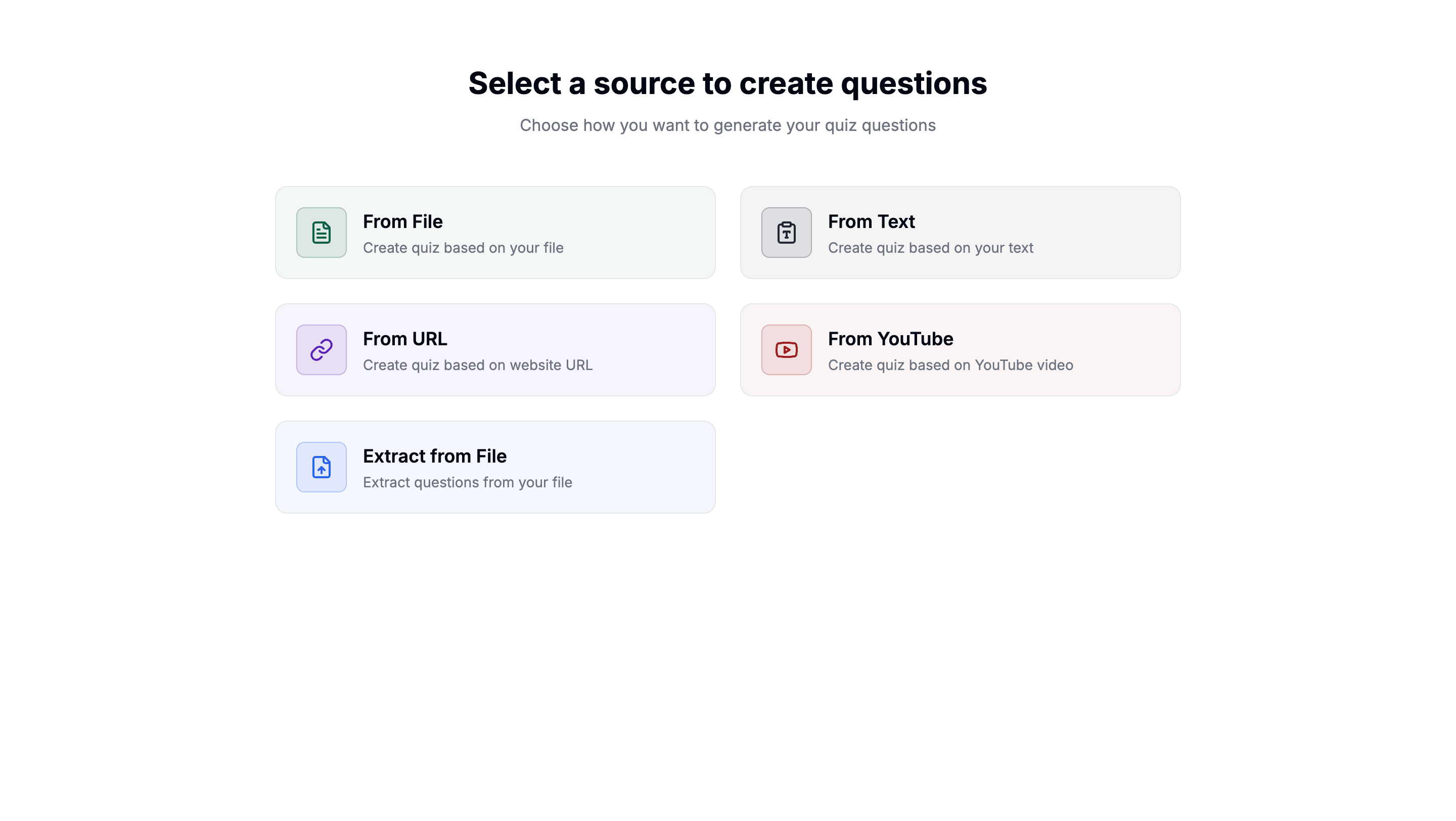
QuizRise offers file, text, URL and YouTube sources, plus an option to extract existing questions from a file.
Before sharing an AI-generated quiz, teachers should check that its questions and answers are accurate, clear and appropriate for the learning objective. I explain the criteria I use for this review in my comparison of AI quiz generators for teachers.
For me, the most important part begins after students respond.
Whether I share a quiz through a public link or through Classroom, I can review its quiz-level results. These include total and completed attempts, average score, completion time, score distribution and question-level performance. Attempts are not necessarily unique students.
About the screenshots: The statistics screens below contain demo data from different examples. They illustrate the interface and are not results from my students or evidence of learning gains.
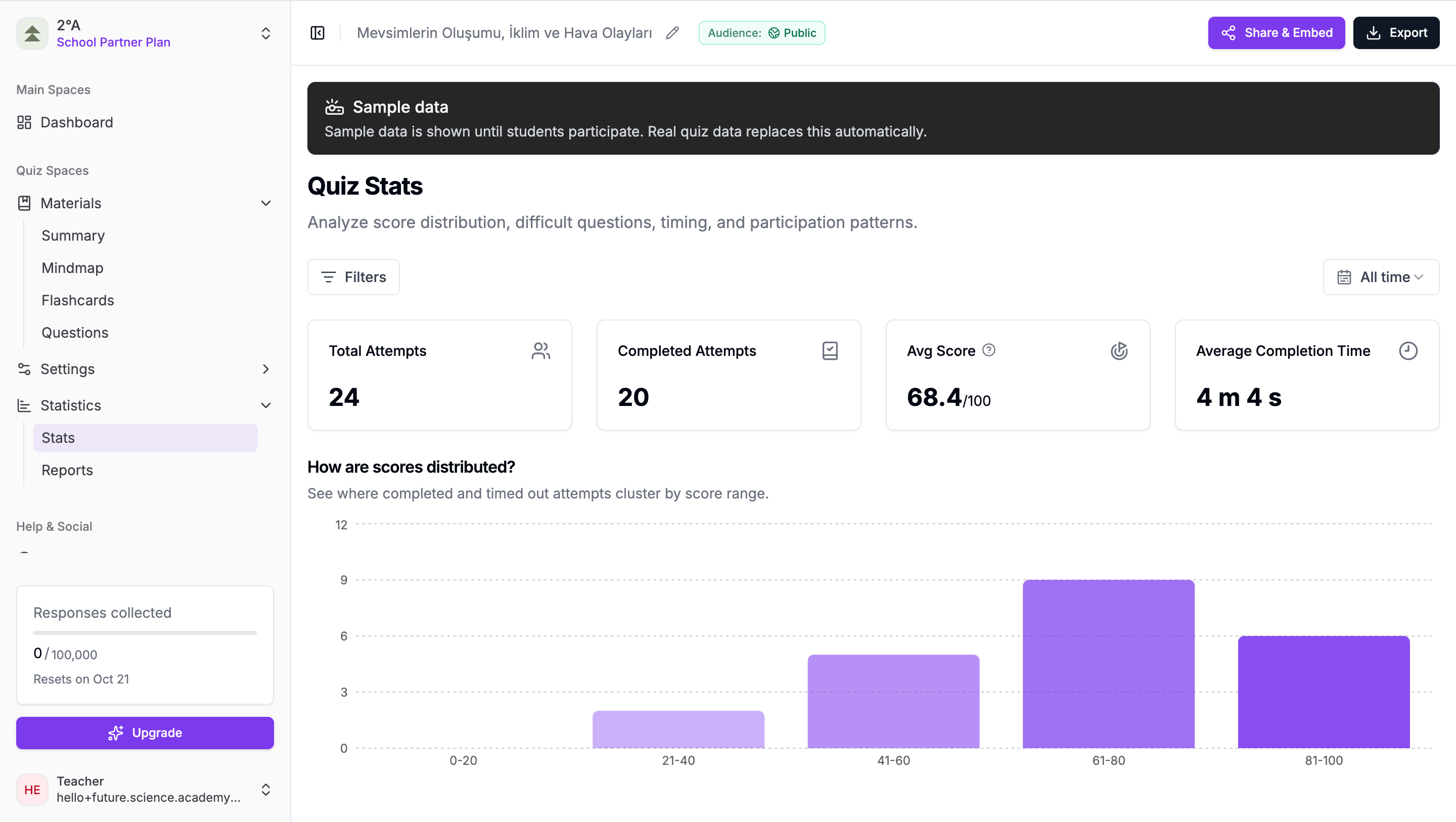
Demo quiz statistics show an overview of participation, scores and completion time.
Question-level results are particularly useful to me. I can review questions with lower average scores, see which answers students chose and examine time spent on each question.
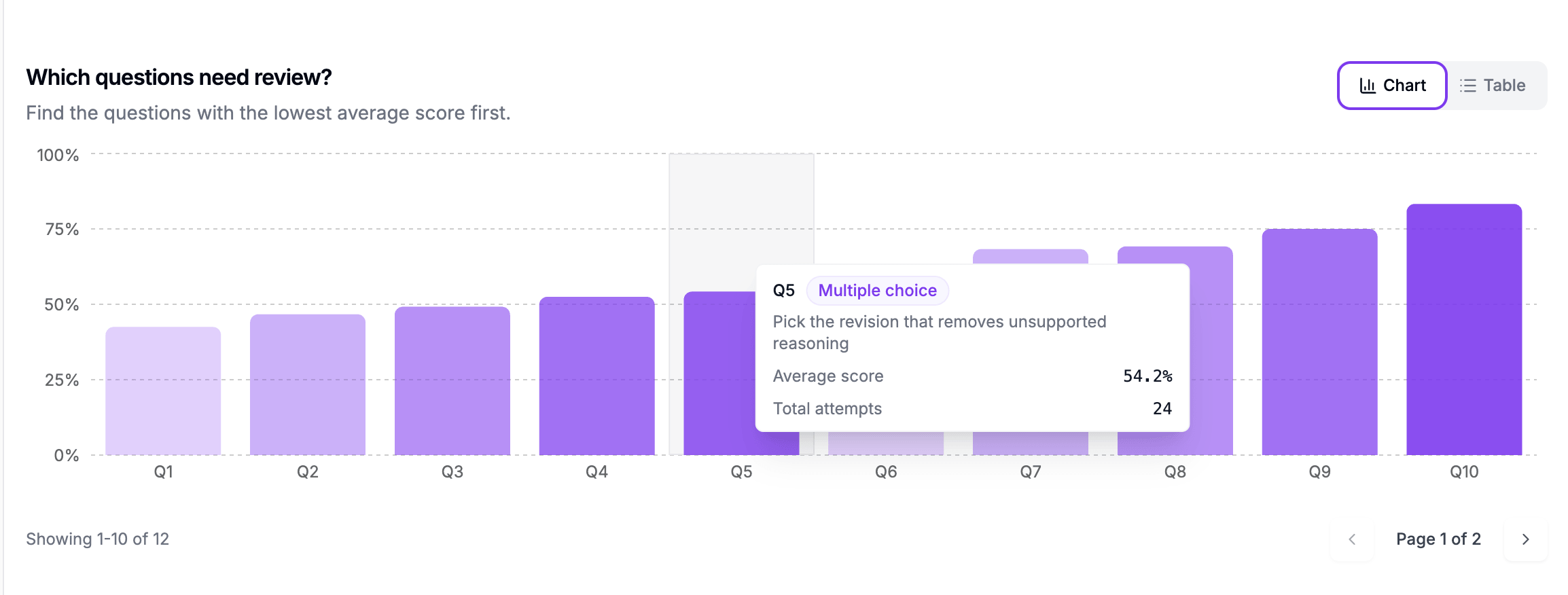
This demo chart helps illustrate how to find questions that need review.
For example, a class average of 70% tells me something different from finding that many students selected the same incorrect answer. A shared response pattern prompts me to consider whether there is a common misconception or a part of the topic I should revisit.
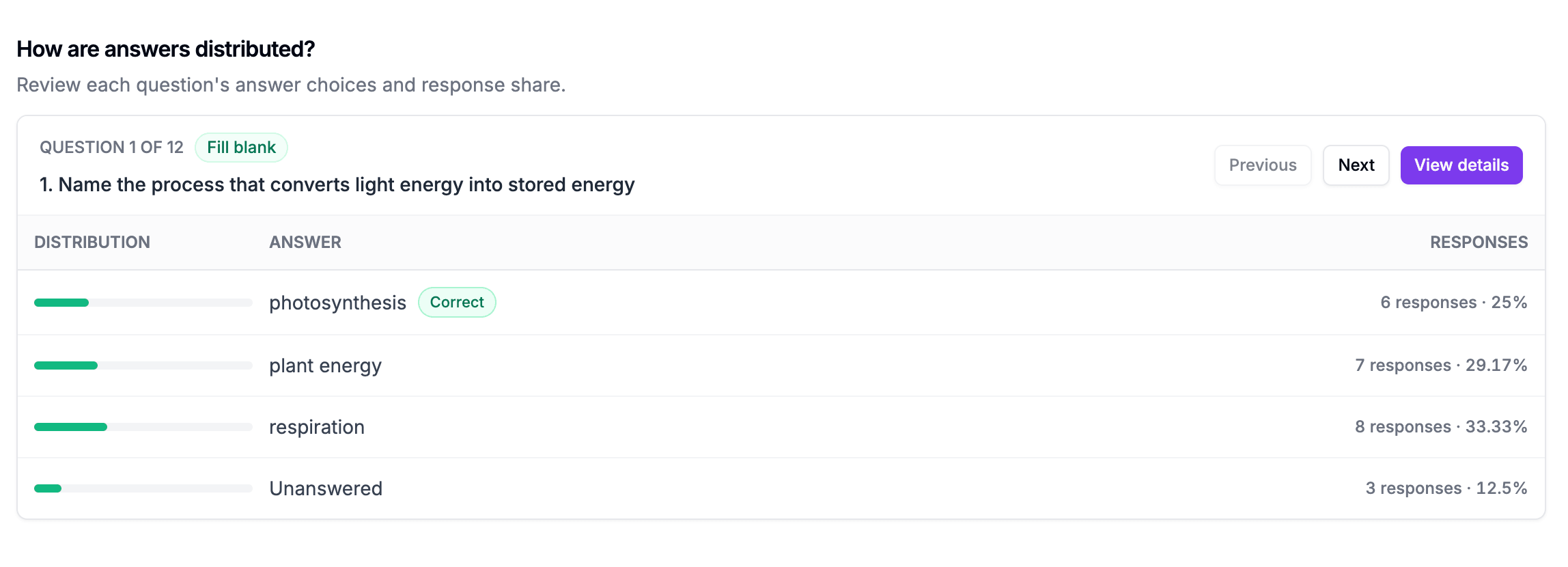
Demo answer distribution shows correct, incorrect and unanswered responses for one question.
QuizRise also provides Classroom-level analytics. When I invite students to Classroom and share quizzes with them there, I can follow their activity across different tasks. I can see attempt counts, questions practiced, flashcards studied and last activity, then open a student’s details to review their results.
This lets me look beyond a single score. Quiz visibility settings explain the distinction between public access and sharing with Classroom members; Classroom is the workflow I use to follow students across their work.
Data is the starting point for my next teaching decision, rather than the decision itself. I may revisit part of a topic, prepare new questions, try a short experiment or offer extra support to particular students.
AI can make preparation quicker, and technology can make student activity easier to see. The teacher still decides what those results mean in the classroom.
How I use QuizRise Classroom for formative assessment
One of my main needs is to see which quizzes a student has attempted and how their results change over time.
A single quiz result is not enough to understand a student’s learning. After seeing where they are today, I also want to see what changes after revision, extra practice or a different teaching approach.
I invite my students to QuizRise Classroom and share quizzes directly with the class. Students continue their work through their own accounts, so their activity at different times can be followed under the same student. For the full Classroom setup, including separate classes and study access options, see how I use QuizRise Classroom as a teacher. Schools that want this setup for every class can use QuizRise for Schools. For more classroom ideas, see these formative assessment examples and tools.
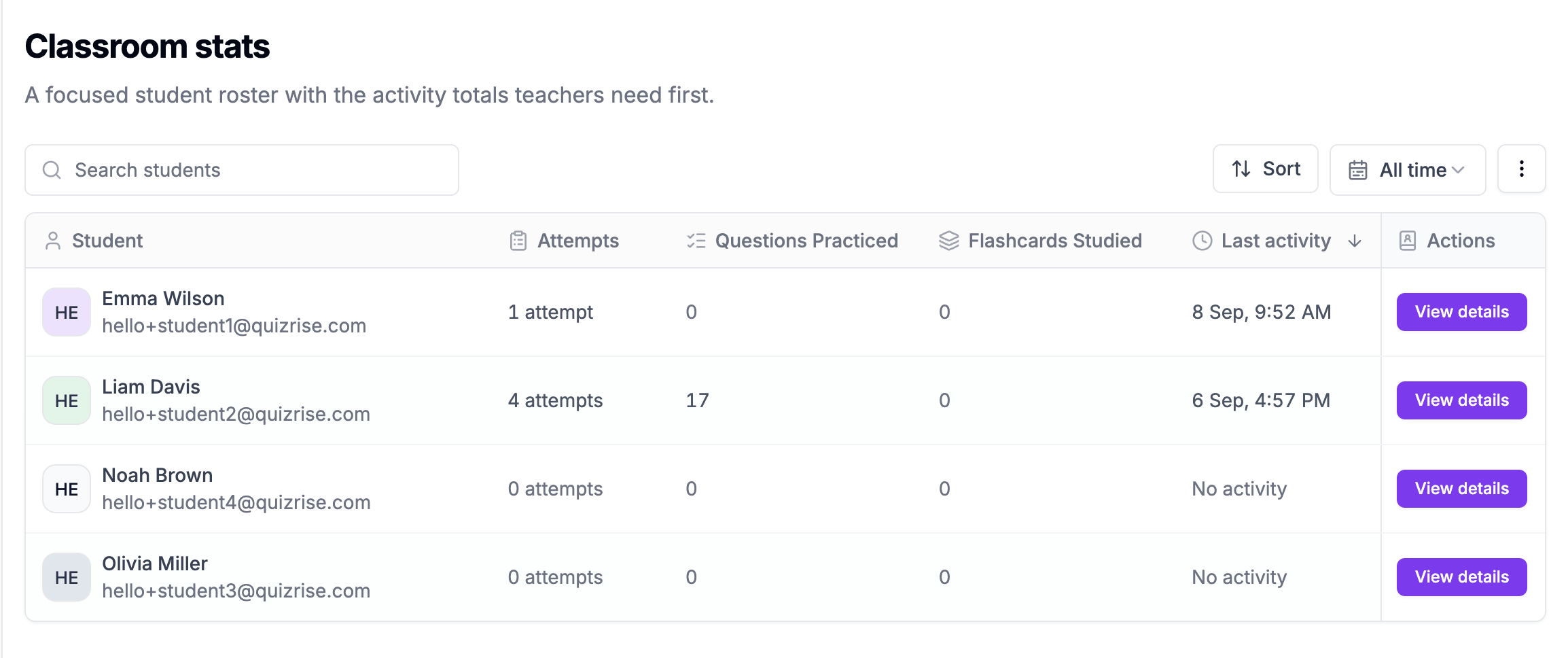
Demo Classroom statistics show student attempts, practice totals and last activity.
In Classroom Stats, I can review students’ activity, questions practiced, flashcard use and last activity. Opening a student’s details lets me examine their average score and results from individual quizzes and study attempts.
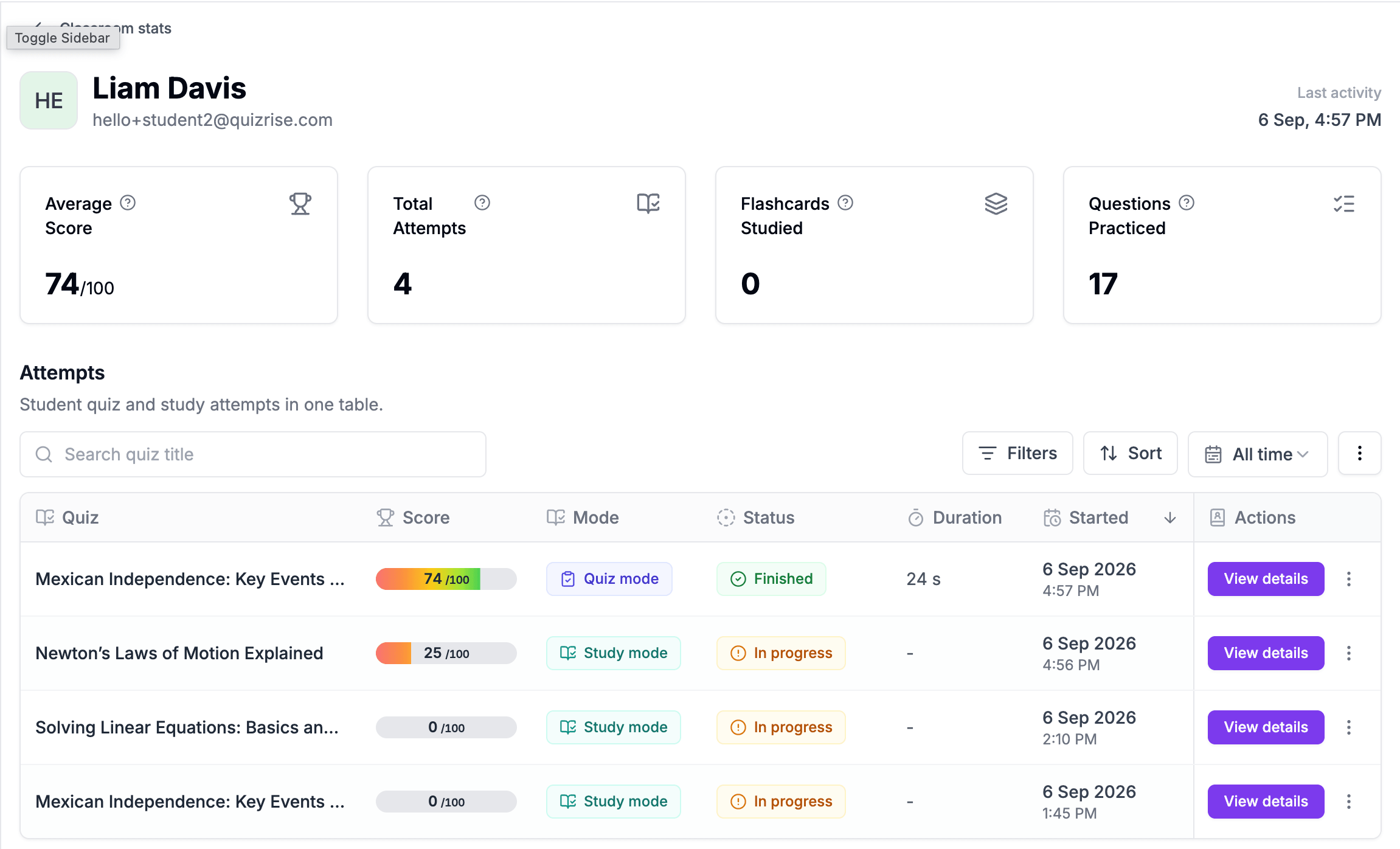
This demo student view includes quiz and study attempts, including work still in progress.
Imagine that a student struggles in an initial assessment on Pressure. After revisiting the topic and offering extra practice, I can follow how their results change in later assessments.
I am looking beyond “What score did this student get?” to ask: “How is this student progressing, and where do they still need support?”
That is my main reason for using Classroom in formative assessment: to consider a student within an ongoing learning process, rather than through one test result. Scores and activity give me clues to investigate; they do not establish understanding on their own.
When I use formative assessment during a lesson
I do not see formative assessment only as a check after teaching a topic. It can begin before the lesson and continue throughout learning.
Before starting a new topic, I may use a short assessment to find out what students already know. For example, before DNA and the Genetic Code, I might ask a few questions about cells, nuclei, chromosomes and inherited traits. My aim is to identify prior knowledge and possible misconceptions. If many students struggle with a basic idea, I may need a short review before moving on.
Assessment continues during the lesson. A short quiz of 5–10 questions after introducing a concept can help me check understanding. If many students struggle with the same question, I may return to that point, give a different example or explore it through a short experiment or activity.
Another important step is assessing the same topic again. After identifying a gap and responding to it, I may use a new assessment. I want to look beyond “Did the score increase?” and consider whether the student’s earlier difficulty has changed.
A higher class average does not mean every student has progressed to the same extent. Some students may still need help even when the class appears to understand an objective overall. Following individual results across quizzes helps me notice those students.
For me, the process becomes a cycle:
Check prior knowledge → teach → assess → identify gaps → adjust teaching → reassess.
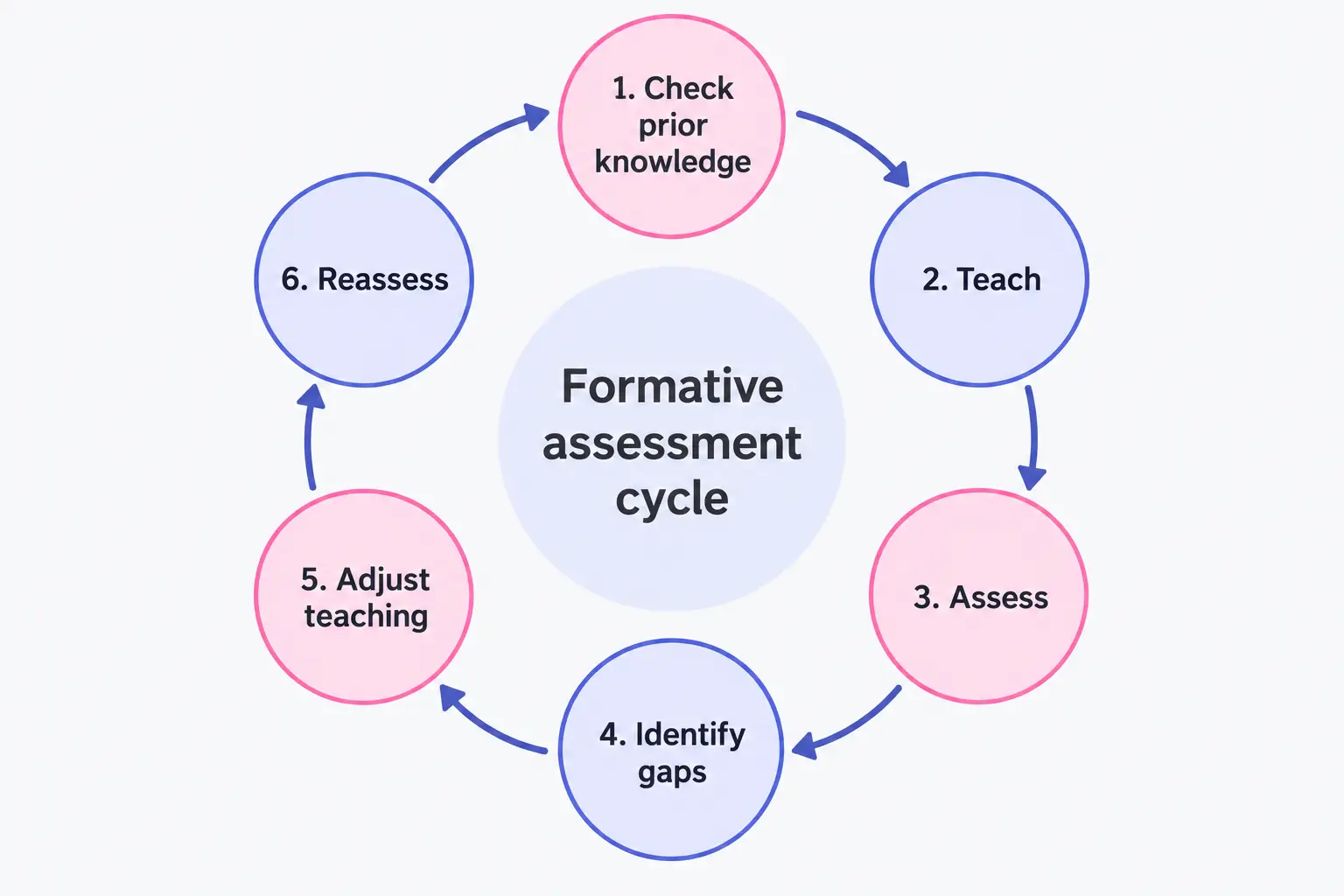
The formative assessment cycle I follow in science lessons.
This cycle is what makes formative assessment useful in my teaching.
Making assessment part of learning in science lessons
In science, I want students to do more than remember information. I also want them to interpret it, connect it to different situations and use it when they meet a new problem.
Formative assessment helps me shape my teaching around those needs. If students struggle to interpret a model in Seasons and Climate, I can adjust the next lesson. If they struggle to apply their knowledge of Pressure to an everyday problem, I can revisit the objective through other examples, experiments or activities.
AI helps me prepare short assessments and different questions for the same objective more quickly. Quiz and Classroom analytics make it easier to review those assessments at both quiz and student level.
The teacher remains at the centre of the process. Interpreting a drop in a graph, a cluster of incorrect responses or a student’s results over time requires my judgment about the students and the lesson.
I use AI to help me see my students’ learning more closely and respond to it through my teaching. Perhaps the most useful change is that I can get more from the assessments I already make.
What matters to me is noticing why a student is struggling a little earlier and responding while learning is still taking place. When I walk into the next lesson, I want more clues about what this class needs now, alongside its average score.
Frequently Asked Questions
What is AI-powered formative assessment?
AI-powered formative assessment uses AI to prepare short, frequent checks for understanding, such as quizzes on one learning objective. The teacher still reviews the questions, interprets the results and decides what to change in the next lesson.
What is the difference between formative and summative assessment?
Formative assessment monitors learning while it is happening so that teachers and students can respond. Summative assessment evaluates learning at the end of a unit against a standard or benchmark.
What are the types of formative assessment?
Lists of formative assessment types differ between sources. In my science lessons I use three moments: a short check of prior knowledge before a topic, quick quizzes during the lesson, and a reassessment after I adjust my teaching.
What is an example of AI formative assessment?
After a lesson on pressure, I can use AI to prepare a short quiz that asks students both to recall the rule and to apply it to everyday objects. If many students answer the recall questions correctly but miss the application questions, I revisit the idea with new examples before moving on.
Can AI replace teacher judgment in formative assessment?
No. AI can make question preparation faster and analytics can make response patterns easier to see, but scores and activity are clues. Deciding whether a pattern shows a misconception, an unclear question or a need for extra support remains the teacher's job.